

close
Choose Your Site
Global
Social Media


Views: 0 Author: Site Editor Publish Time: 2026-11-27 Origin: Site


When choosing a vessel, buyers often prioritize horsepower output or hull configuration. However, boat layout is not a mere aesthetic choice. It is a critical operational variable determining daily fuel burn, crew fatigue, and catch rates. Minor structural inefficiencies add up fast. For commercial operators, charter captains, and serious sportfishers, these small layout flaws multiply. They accumulate over thousands of hours on the water. A poorly designed deck turns a capable hull into a logistical nightmare. Every wasted step across the deck costs you valuable time. You also lose precious physical energy during intense fishing sessions. Evaluating a vessel requires analyzing its floor plan, storage placement, and helm positioning. You must understand how these factors directly impact weight distribution and crew workflow. In this guide, you will learn how to identify costly deck bottlenecks. We will explore how specific designs affect hydrodynamic drag. You will discover functional frameworks to stress-test any layout before finalizing your purchase.
Deck layout directly influences a vessel’s center of gravity, altering hull performance and daily fuel efficiency.
The center console fishing boat configuration maximizes 360-degree fishability but requires specific storage and weather-protection trade-offs.
Ergonomic floor plans eliminate operational bottlenecks, reducing crew fatigue and minimizing safety risks during high-stakes moments.
Pre-purchase evaluations must test layout under fully simulated design loads, not just dry weight.
Operational costs remain hidden until you launch the vessel. An inefficient deck drains your resources silently every single day. It forces unnecessary movements and awkward transitions. Crew members burn extra energy simply navigating around poorly placed consoles. This translates directly into lost operating efficiency. Every extra maneuver across a cluttered deck chips away at your profit margins. You must stop viewing layout as a luxury. You must view it as a primary driver of operational success.
Cramped thoroughfares create massive workflow bottlenecks. Consider the path routing between the helm, bait station, and transom. In a fishing boat, every second counts during a critical hook-up. Narrow walkways block movement when multiple anglers respond to a strike. Teammates bump shoulders. Leaders tangle. You lose fish simply because the deck prevents smooth transitions from the rod holder to the fighting stance. A proper layout guarantees unimpeded pathways during these chaotic moments.
Asymmetrical loading introduces severe performance risks. Poorly placed static weights hurt your speed and economy. High-capacity livewells and large fish boxes dictate your center of gravity. When designers place them too far off-center, the vessel lists aggressively. This listing dramatically increases hydrodynamic drag on one side of the hull. Your engines must work harder to maintain a straight track. You burn significantly more fuel daily. Symmetrical weight planning prevents this costly drag.
Poor deck flow also demands a steep safety and compliance toll. Cluttered spaces introduce immediate trip hazards during rough seas. High steps and scattered gear inevitably lead to crew fatigue. Exhausted crews make crucial mistakes. You increase your liability and risk costly downtime. Regulatory bodies demand clear egress routes for a reason. Ignoring these functional requirements endangers your crew and jeopardizes your entire operation.
Let us objectively assess the most popular layout choice for modern day-trip operations. The center console fishing boat dominates the current market. Operators favor it for its unmatched versatility and open-deck freedom. It strips away bulky cabins to prioritize pure angling space. This solution category fits perfectly into fast-paced, high-action marine environments. You must evaluate it based on your specific daily mission profile.
The operational advantages are substantial. This design offers true 360-degree deck access. You enjoy a highly centralized center of gravity. Anglers can track a fast-moving fish from bow to stern effortlessly. They face no structural obstructions or narrow cabin walkways. This speeds up landing rates significantly. The captain also maintains excellent visibility over the entire crew. You can direct the action seamlessly from the central helm station.
However, every design presents necessary trade-offs. Center consoles lack structural weather protection. Sun, wind, and spray exposure reduce crew endurance over long shifts. A simple T-top cannot replace a fully enclosed cabin during a storm. They also provide limited enclosed secure storage. You cannot lock away expensive gear as easily as you can inside a walkaround or cuddy cabin design. You must pack and unpack the vessel more frequently.
We recommend this layout for specific operational profiles. Nearshore charters benefit greatly from the open space. High-mobility sportfishing teams thrive on these unobstructed decks. It yields the highest return on investment where maneuverability outweighs climate control. If your daily operation requires chasing fast pelagic species, this layout excels. If you run multi-day offshore trips in cold climates, you might need a different configuration.
Layout Type | Deck Access | Weather Protection | Storage Capacity | Best Use Case |
|---|---|---|---|---|
Center Console | 360-degree unobstructed | Minimal (T-top only) | Limited enclosed space | Day-trip sportfishing, nearshore charters |
Walkaround | Restricted forward access | Moderate to High | Excellent secure storage | Overnight trips, rough weather operations |
Cuddy Cabin | Bow access over cabin | High (enclosed bow) | Maximum secure storage | Family cruising, cold climate fishing |
You must connect deck layout directly to hydrodynamic efficiency. Weight placement dictates how a hull cuts through the water. A balanced deck minimizes wetted surface area. When you distribute weight properly, the bow rises to the correct angle. The hull planes efficiently. Poor layout forces the hull to plow water. This plowing action destroys your fuel economy and strains your propulsion system unnecessarily.
Design loads shift constantly in practice. Variable loads change your center of gravity throughout the operating day. Fuel tanks drain steadily. Ice melts in the coolers. Fish boxes fill up rapidly. Crew members move around the deck. A smart layout anticipates these dynamic shifts. It places heavy, variable items near the vessel's natural center of buoyancy. This prevents extreme bow steering or stern squat as the day progresses.
Choose a layout matching your specific hull type. Deep-V hulls require precise lateral balance to prevent leaning. Flat bottom hulls suffer greatly from improper fore-and-aft loading. Matching the layout to the hull maintains optimal planing angles. A deep-V hull with an off-center livewell will lean into the wind. You will constantly fight the steering wheel. Proper integration eliminates these handling headaches.
Balanced layouts deliver quantifiable benefits. You reduce daily fuel expenditure significantly. Engines experience less mechanical strain. Your overall emissions drop. A well-planned deck translates directly to an efficient running attitude. You spend less money at the fuel dock and more time actively fishing.
Common Weight Distribution Mistakes to Watch Out For:
Placing massive 50-gallon livewells at the extreme stern, causing severe squatting.
Offsetting heavy console battery banks without a proper counterbalance on the opposite side.
Ignoring the dynamic weight of shifting catch in poorly baffled fish boxes.
Mounting heavy radar arches too high, raising the vertical center of gravity and inducing roll.
Assess layouts by observing daily human tasks. A good design supports natural human biomechanics. It minimizes reaching, bending, and excessive twisting. You must look past shiny features and focus on functional outcomes. How easily can a mate grab a gaff? Can the captain reach the radio without leaving the wheel? Ergonomics dictate the speed and safety of your daily operations.
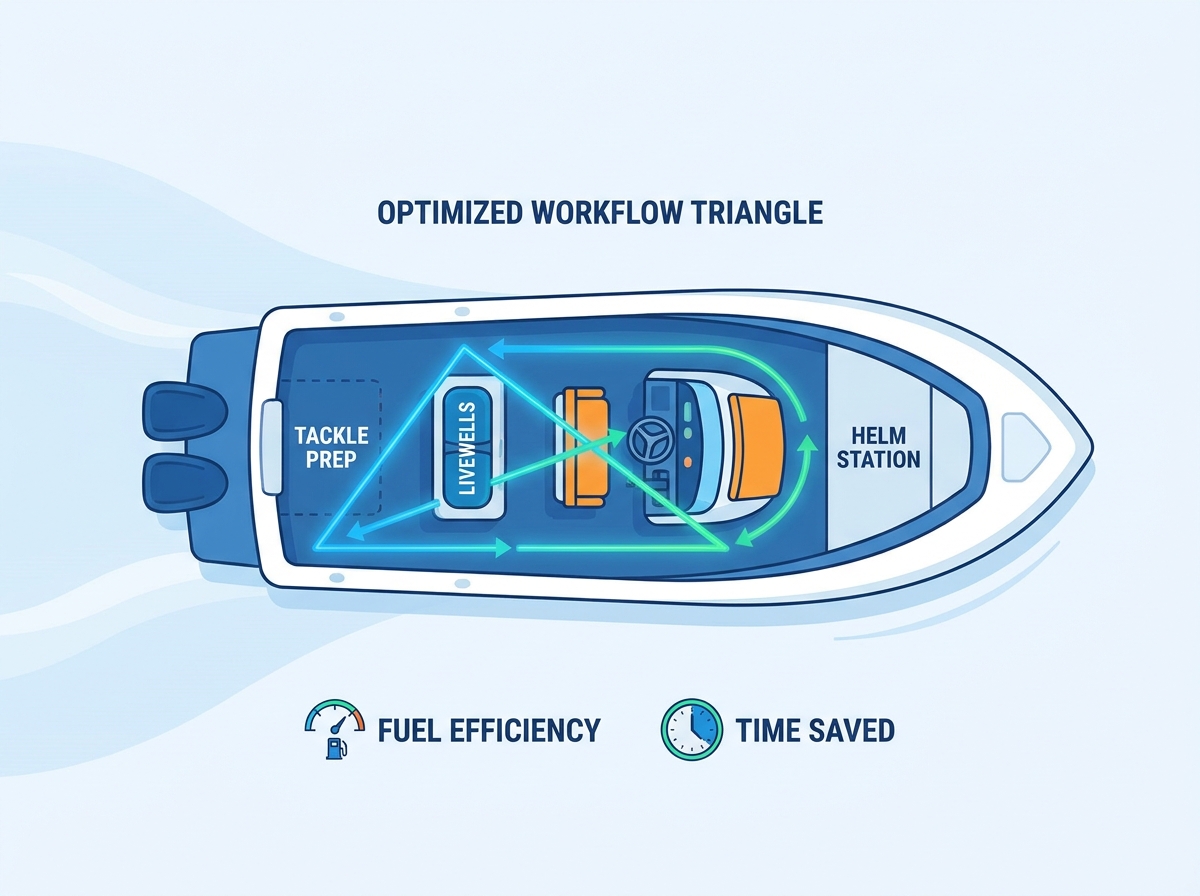
Evaluate the core functional zones using the "Work Triangle" concept. Measure the distance and clearance between the helm, tackle prep station, and livewells. Tight clearances slow down work. Too much distance wastes valuable steps. You need an unobstructed rhythm. A mate should pivot from the bait station to the rod holder in one fluid motion. Any layout disrupting this triangle costs you efficiency.
Steps to Evaluate the Work Triangle:
Stand at the helm and simulate reaching for the primary bait station.
Measure the walking distance from the livewell to the primary casting deck.
Check for tripping hazards along the direct path between the console and the transom.
Ensure two crew members can pass each other safely within the triangle during a hook-up.
Pay close attention to gunwale and deck dimensions. Your feet need adequate toe-kick space. You must tuck your boots under the gunwale for leverage during a tough fight. Proper gunwale height ensures safety by hitting the angler above the knee. Strategic scupper placement clears deck water rapidly. If water pools near the helm, the layout fails basic drainage requirements.
Extended shifts demand smart fatigue mitigation. Helm line-of-sight must remain clear at all planing angles. Leaning posts must support proper spinal posture. Anti-fatigue deck treatments save your joints from constant pounding. These small ergonomic details sustain crew output over a grueling 12-hour day. A comfortable crew stays alert, makes fewer mistakes, and lands more fish.
Never finalize a purchase based on a dry walkthrough at a boat show. You must stress-test the layout rigorously. Only dynamic testing reveals true operational flaws. A deck looks spacious in a showroom. It feels entirely different when pitching in a three-foot chop. You must implement a strict evaluation framework before committing capital to a new vessel or custom build.
Conduct sea trials by simulating real-world loads. Run the vessel with simulated full fuel tanks. Fill the livewells completely. Bring your maximum expected crew weight. These design loads expose hidden scupper drainage issues. They reveal true planing speeds and fuel burn rates. Testing an empty boat provides false confidence. You must know how the layout performs when pushed to its absolute maximum capacity.
Assess the cost-benefit of modularity versus fixed layouts. Removable casting decks offer great seasonal flexibility. Modular seating allows you to reconfigure the deck for different charter groups. However, structurally integrated components offer superior rigidity and rattle-free performance. You must choose based on your daily mission profile. Do not buy modularity if you never plan to change the configuration.
Verify strict industry standard compliance. The layout should adhere to ABYC or local commercial safety rules. Check deck drainage times under load. Measure rail heights to ensure passenger safety. Ensure clear egress routes around the console. Safety compliance protects your operation from regulatory fines and unexpected downtime. A compliant layout is inherently a safer, more efficient layout.
An efficient layout handles much more than just gear storage. It aligns structural balance directly with the exact daily workflow of your crew. This synergy determines your ultimate operational efficiency. When the deck flows naturally, your crew works faster, safer, and with less fatigue. You burn less fuel and maximize your time actively fishing.
Stop looking purely at aesthetics when evaluating a vessel. Map your specific daily operational bottlenecks first. Take these workflow maps into targeted sea trials. Test heavily loaded shortlisted vessels to ensure they operate smoothly under real pressure. Demand a layout that works as hard as you do.
A: A 50-gallon livewell adds over 400 pounds of dynamic weight. Aft placement can cause severe stern squat. This increases hydrodynamic drag and ruins fuel economy. Integrated mid-ship placement optimizes the center of gravity. It keeps the hull balanced, allowing the vessel to plane faster and run more efficiently.
A: Center consoles are typically lighter, which improves base fuel economy. However, efficiency ultimately depends on windage (aerodynamic drag) and weight distribution. A poorly loaded center console will burn more fuel than a perfectly balanced walkaround. You must distribute your gear load evenly across the layout to maximize efficiency.
A: Design loads represent the maximum weight the boat is engineered to carry. This includes crew, gear, fuel, and water. Evaluating a layout requires understanding how it performs when these loads are maxed out. A layout might drain water perfectly when empty but flood the deck when fully loaded.


