

close
Choose Your Site
Global
Social Media


Views: 0 Author: Site Editor Publish Time: 2026-11-20 Origin: Site


Selecting a commercial vessel involves more than choosing a personal hobby craft. Your choice dictates your operating season, defines your target client demographics, and directly impacts your bottom line. Whether you are running a high-turnover charter service or specialized expeditions, the hull configuration serves as the engine of your business model. You must balance the agility and expansive deck space of an open deck design against the weather protection and extended operating windows offered by a more structured vessel. This article provides a balanced, performance-focused framework for evaluating which design best supports your specific commercial goals. By analyzing your local climate, target revenue streams, and client expectations, you can make an informed decision that scales with your fleet’s growth. We will explore how different configurations influence your operational success, maintenance cycles, and long-term profitability in the competitive charter market.
Revenue vs. Weather: Cabin fishing boats minimize weather-related cancellations and extend the operating season in volatile climates, directly impacting annual revenue.
Operational Efficiency: Center consoles maximize client headcount for day trips and offer superior 360-degree fishability, often with lower fuel and maintenance overhead.
Total Cost of Ownership (TCO): Cabin models carry higher upfront costs and heavier fuel consumption, but can command premium charter rates for overnight or corporate bookings.
Client Demographics: Hardcore anglers typically prefer the deck access of a center console, while family or corporate groups prioritize the comfort and amenities of an enclosed cabin.
To choose the right vessel, you must first audit your business requirements. Success depends on aligning your equipment with your specific income strategy. Start by identifying your core revenue stream. Are you conducting high-turnover half-day trips, or do you focus on multi-day offshore excursions? The demands for these models vary significantly. Consider your geographic reality as well. Examine historical weather data for your specific region. Frequent storms in the Florida Keys require different equipment than the sustained cool temperatures of the Northeast. A vessel that loses too many days to rough conditions will struggle to break even. Your client experience goals play an equal role. Do your customers demand climate control, private heads, and shelter from the spray? If so, investing in a cabin fishing boat may be the key to securing repeat bookings. Always check local maritime regulations. Enclosed spaces often trigger different passenger limit rules compared to open deck layouts. Ensure your chosen design remains compliant with your local authority requirements before purchasing.
The center console configuration remains the industry gold standard for many charter operators. Its primary advantage is 360-degree fishability. Clients can fight fish simultaneously around the entire perimeter of the vessel without running into structural bottlenecks. This layout is perfect for fast-paced, active fishing trips where mobility is everything. Maintenance is another key benefit of the open deck. Cleaning is straightforward, allowing for rapid turnarounds between morning and afternoon charters. You spend less time scrubbing carpets and more time welcoming your next group of clients. Additionally, these boats typically feature shallower drafts. This versatility allows you to chase species inshore or reach offshore grounds with greater speed. However, you must consider the operational risk. The open deck exposes your passengers to rain, intense sun, and salt spray. Adverse weather can force you to cancel trips or terminate them early. For a business built on customer satisfaction, these interruptions can lead to poor online reviews and lost revenue.
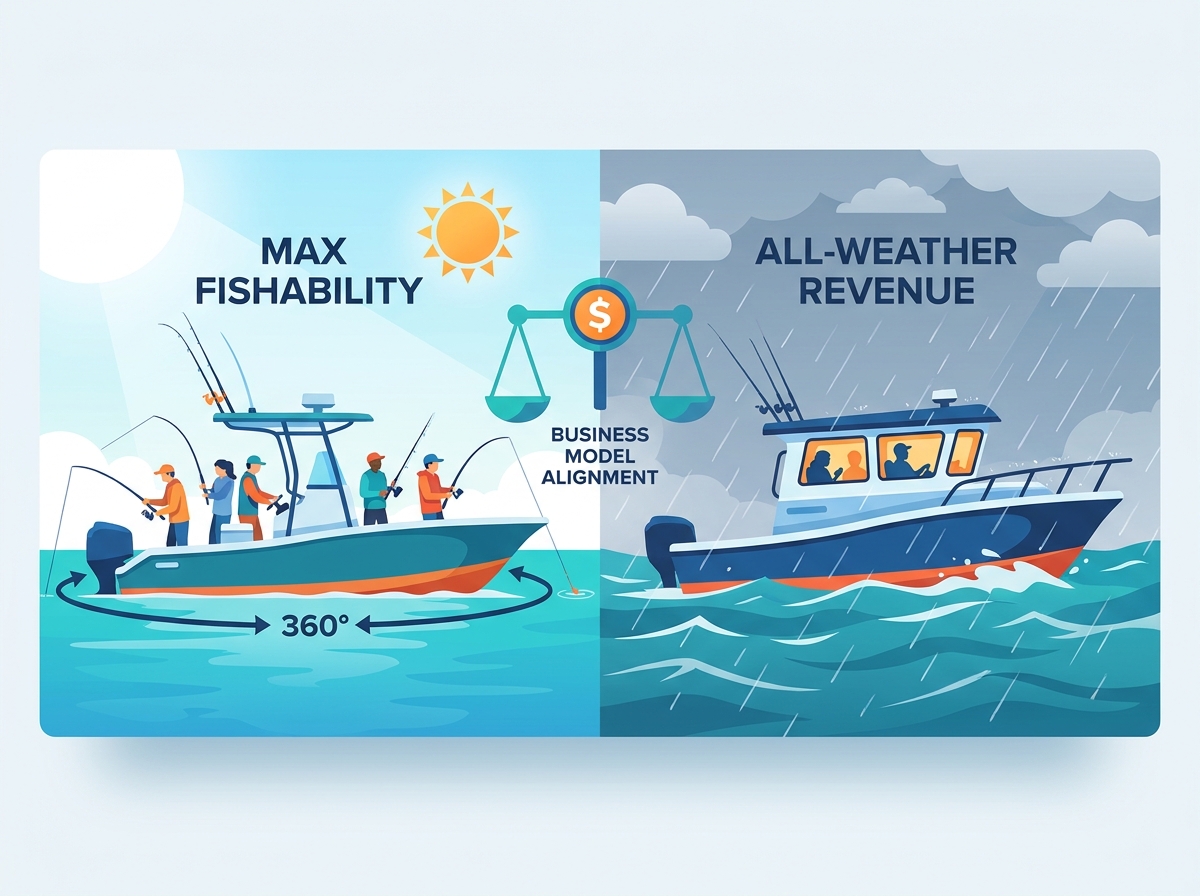
An enclosed vessel transforms your business potential in colder or volatile climates. By providing shelter, you secure revenue during shoulder seasons that would ground a center console fleet. This reliability allows you to maintain consistent income year-round. Cabin models also enable premium pricing strategies. You can offer overnight adventures or luxury corporate packages that require kitchens, berths, and air conditioning. These services command higher margins than standard day charters. Furthermore, providing a climate-controlled helm reduces crew fatigue significantly. A rested captain is a safer, more alert captain, especially during long offshore transits. You must navigate specific trade-offs here. Enclosed boats often have restricted forward visibility during docking. They also provide less room for casting from the bow. Increased windage can also complicate drift patterns while fishing. You must weigh these technical limitations against the massive advantage of keeping your clients dry and comfortable in any weather condition. If you want a fishing boat that works as hard as you do in all seasons, this is the path forward.
You should compare the actual usable square footage for active fishing. While a cabin offers luxury, it sacrifices some deck area. Consider a walkaround configuration if you want a middle ground. It allows for weather protection while keeping the bow accessible for your anglers.
Fuel consumption represents a major operating expense. Center consoles are generally lighter and more aerodynamic, resulting in better fuel economy. Cabin vessels often face higher drag and weight, which increases your daily burn rate.
Maintenance requirements differ significantly between these styles. A cabin boat introduces HVAC, advanced plumbing, and sophisticated electrical systems. These require specialized technicians to service correctly. A center console remains functionally simple and usually cheaper to repair.
Use the following table to quickly assess which model fits your primary business objective.
Table 1: Operational Comparison Overview
Feature | Center Console | Cabin Fishing Boat |
|---|---|---|
Weather Protection | Minimal | Excellent |
Angling Space | Superior (360 degrees) | Moderate (Restricted) |
System Complexity | Low | High |
Ideal Demographic | Sport Anglers | Families/Corporate |
Seasonality | Warm/Predictable | All-Weather |
Capital expenditure is only the start of your journey. You must consider the long-term economics of your fleet. Start by comparing the purchase price of similar hull sizes. Cabin models usually require a higher upfront investment due to the structure and interior systems. Check your local slip and storage costs. Large, tall cabin profiles might restrict your options for dry-stack storage, potentially forcing you into more expensive wet slips. Insurance premiums also vary. Your insurer will factor in the replacement value of the boat, its intended range, and the complexity of the systems onboard. Resale value behaves differently across markets. In northern regions, a well-maintained cabin boat holds its value as these vessels remain in high demand. In the southern sport-fishing hubs, center consoles often dominate the secondary market. Research your local market before making your final selection.
Selecting the right vessel is a strategic math equation. Your answer depends on your target clientele, your regional climate, and your desired charter rates. A center console serves as the best choice for speed, high capacity, and lower daily overhead. Choose a cabin boat if your business focuses on premium, all-weather, or multi-day services. To move forward, audit your past year of operations. Review your weather cancellations and client feedback to identify your biggest bottleneck. Solving that single problem will define your next investment and ensure your business continues to thrive.
A: Yes, you can use a center console for commercial offshore fishing, provided it meets size, fuel capacity, and safety compliance standards. However, crew endurance and passenger comfort become limiting factors during long trips compared to the shelter provided by a cabin vessel.
A: It depends on the replacement value and the systems onboard. More complex systems like plumbing and HVAC can slightly increase hull insurance costs. However, the added safety of an enclosed cabin can sometimes reduce specific passenger liability risks during rough conditions.
A: Resale value is highly localized. Center consoles tend to depreciate slower in warm, coastal sport-fishing hubs where they are the standard. Conversely, cabin models retain premium pricing in colder or more unpredictable climates where year-round weather protection is highly valued by buyers.
A: A walkaround model is an excellent compromise for mixed-demographic charters. It provides partial weather protection while retaining forward deck access for active fishing. While you may sacrifice some interior cabin volume compared to a full express model, the added versatility is often worth it for charter operators.


